
Lillee Jean Stance on Legal Intellectual Property Copyright Protections | Project: Bullyish
Updated: Aug 21

Digital rights are straightforward. They pertain to human rights. Digital rights live online and relate to your legal human rights. Dignity, respect, equality, justice, as well as, consent all live as digital rights.
Due to the simplicity of crafting misleading statements online and the ease of fostering an unstable and unsafe online environment, the right to consent has become a significant concern.
"The right to restrict users from editing or saving your content; restrict or prevent users from sharing or forwarding your product or content; Restrict or prevent users from printing your content; Disallow users from creating screenshots or screengrabs of your content. Copyright education: Many people pay little attention to the copyright details of the content they own. DRM helps organizations clearly communicate what customers can and cannot do with their digital media, which in turn educates users about how copyright and intellectual property work." - Digital Guardian
Copyright Enforcement: Platform Responsibility
For example, rights have been enforced by companies such as Netflix, which blocks screengrabs, and Apple, which prevents music from being pirated. Platforms with "easy access to creation" tools and low levels of moderation lead to people paying little attention to copyright education and information about pirated content they are not allowed to use.
The right to fair use is not a protective seal; in other words, if you pirate a piece of content from a user online and do not ask permission, you have violated their digital rights. This is a critical legal distinction reaffirmed by the Supreme Court in the landmark case of Andy Warhol Foundation v. Goldsmith (2023). In this case, the Court sided with the photographer, affirming that a commercial use of a copyrighted work is not a fair use if it has a substantially similar purpose to the original.
"Viewers everywhere enjoy watching their favorite films, series, and events online. It's easy to recognize that it's difficult to know if what you're watching is legitimate or not.
The reality is, a lot of the content shared on certain platforms is stolen, just a fact. This is not your fault, though, as the viewer. You are being fed misinformation, and it's not always easy to tell the difference between a legal stream and an illegal one. It's manipulatively marketed.
These platforms that distribute stolen content without permission harm the artists, writers, actors, and crews who create the work you love."
This decision solidifies the rights of all creators, including filmmakers, to utilize any legal means available to ensure their work is protected, as a defense of "fair use" is not a valid justification for unauthorized commercial exploitation.
A Filmmaker's Stance on Intellectual Property
When it comes to copyright, there needs to be actual legal representation. Some platforms don't provide on-staff lawyers to review legitimate copyright claims. They're workers "taking" claims, which would shock most.
As an independent filmmaker and entertainer, I have made it my mission with Bullyish to address the protection of creative work and intellectual property concisely. So many in the industry have had our films stolen and profited upon. It simply is illegal, and not just.
The process of safeguarding creative assets, from copyrighted films to registered art pieces, can be complex, but does it have to be, though? Things in my eyes should be black and white. Hand in valid copyright papers - valid acceptance. That never happens simply, however.
Speaking to my own experience in providing legitimate government-registered copyright paperwork for my films and photographs, only to face a brick wall with platforms protecting theft, it has only strengthened my resolve to ensure that entertainers' rights for copyright are upheld.
In an isolated incident, with a high-powered platform, I provided actual paperwork of my copyright (the physical Government papers you received with a stamp), and the platform allowed me to be exploited by allowing the violator to publish the private legal emails on Twitter and their channel.
It seems if a stolen property earns a lot, has a ton of views, and the smug thief hides behind "fair usage" (which is a nice way of admitting to guilt when you colorize, distort, and prove you've stolen MORE by alteration), the theft remains LIVE, and not taken down.
Now get this, for fear of my safety, I even had the police CC'ed on the emails (I have an open criminal harassment investigation on the thief's company for ongoing harassment over the years towards myself, and my family). This is not how copyright should work. Nobody should feel threatened and unsafe. This teeters into entertainers who have been blackmailed - don't do this to us, or we will tactics.
A Proactive Stance on Intellectual Property
Stolen property. Rights owner. REG. VA0002499353
As a professional filmmaker, director, and actress, safeguarding intellectual property is of the utmost importance. I have taken a proactive approach to protecting my work, including my films such as The Trapper Trap, Miss Roxie, and Bullyish, as well as my art pieces. Above are my original, legitimate copyright papers proving my legal ownership of my films and photographic works. Specifically, "Lillee Jean 2019", and my logo on my Site (where my Site policy states pirating will be legally enforced).
Once you publish your work, you own the work. However, I have gone beyond simply publishing my work by securing legitimate copyright registration with the U.S. Copyright Office. This formal process provides irrefutable ownership rights and underscores my commitment to defending my creative assets.
Below, you will notice evident theft on platforms where profits are generated, but not earned by me. I gained a purposefully tarnished reputation from these not individuals, but digital media CORPORATIONS, on these platforms (see my article on this).
Even after submitting the necessary documentation to these platforms to prove copyright ownership and rights for each registered work, the platforms rejected the claims. I later discovered that the individual "investigating" the claims was collaborating with those harassing me and was accessing my site from Kuala Lumpur without using a VPN. This person was not a lawyer, just a random employee of that site.
You could even see one small example of a photo pirated from my website, and not published anywhere else since the date of theft. Not only was my watermark on the lower right side removed, showing bad faith, which clearly says Lillee Jean Productions, but the photo also says all rights reserved, suggesting I do not want any of my Work to be stolen. The photo is registered as well at VA0002499353.
The American company that misappropriated this content must be held accountable. My films were subsequently pirated by these media agencies to damage my reputation further and allow them to profit excessively. All because the platforms were biased due to their own personal gain.
Breaking the law.
As a filmmaker, I am committed to the ethical protection of all creative work. My experience has reinforced the critical need for artists to advocate for their intellectual property and combat unauthorized use.
In one last example, my digital artwork was stolen on several platforms, thanks to these people (corporations) who, for years, have been harassing my family. I recently wrote an article on the abuse, and how I've taken action criminally for these occurrences. As well as being championed by platforms not housing proper legal information and supplying these people with improper information themselves, below you'll see pretty alarming copyright violations.
Not only is my signature on one of the art pieces, but I'm being violated and harassed. They even made videos that they were copyright-struck to create more buzz. The ironic part is that these very people do not want people to steal their artwork, thus proving this ruse is all a sham to unethically confuse viewers.
I must emphasize that the perpetrator’s use of my image unequivocally fails the four-factor test for Fair Use as codified under Section 107 of the U.S. Copyright Act, for the following reasons: (1) Purpose and Character of the Use: The use is highly commercial in nature—monetized for profit, generating advertising revenue, and serving to grow the infringer's audience. It is not transformative; it merely uses my professional image to serve as a visual prop for defamatory content. (2) Nature of the Copyrighted Work: My photograph is a highly creative work—a professional headshot—not a factual document. (3) Amount and Substantiality: The perpetrator used my entire image, which is the 'heart' of the copyrighted work and its commercial value, going beyond any reasonable amount necessary for alleged commentary. (4) Effect Upon the Potential Market: The infringement causes direct financial and professional harm, resulting in the tarnishment of my professional branding and interference with my licensing market.
In the first video of the content displayed above, which used this image, the malicious defamation and intentional effort to damage are not hidden; they are the clear, primary objective. This conduct constitutes willful infringement, as the individual acted with either actual knowledge of their infringing actions or with a reckless disregard for my established legal rights. This person is not a 'critic' but a deliberate commercial vandal, whose actions justify the enhanced statutory damages available for willful infringement under 17 U.S.C. § 504(c)(2).
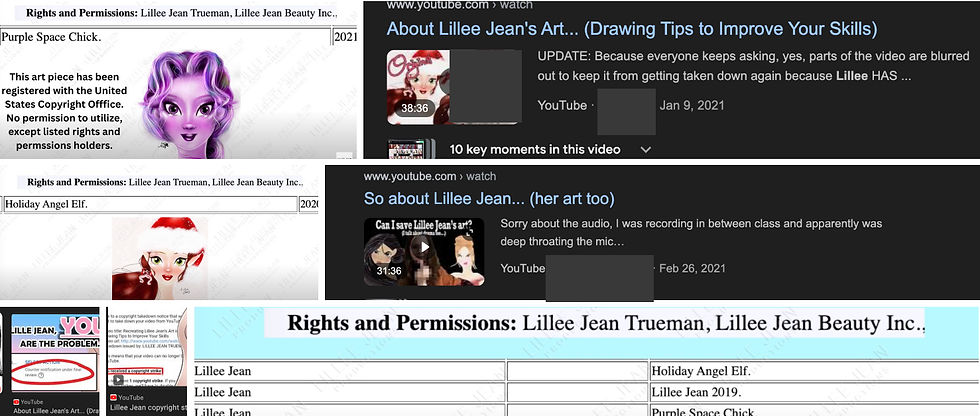
Further examples of theft - my site policy is additionally being violated by platforms such as a well-known platform. They're condoning pirating on insane levels. As a result, these people harassing me (they call themselves the Lillee Jean Clone Cult), utilizing that very platform, are "victims" of "false" copyright claims, despite each claim being legitimate. They harass me, they become victims, thus it becomes a cycle of these internet people with black hat marketing agencies. It's called DARVO.
Willful Infringement and Criminal Threat: My Legal Recourse
My original work.
The initial act of infringement involved the deliberate removal of my proprietary watermark from the lower right corner of my copyrighted photographs. This is a violation of 17 U.S.C. § 1202, the prohibition against the removal or alteration of Copyright Management Information (CMI), and is prima facie evidence of bad faith. The image above, under EU law, since I have moral rights and saved metadata, is protected - even in the USA- from commercialization on such a scale. However, the photograph is actually registered.
These individuals accessed my website and knowingly ignored my established anti-piracy policy, which explicitly states that no unauthorized usage or commercial reproduction is warranted.
Their use was calculated to commercially benefit through digital monetization while simultaneously achieving the criminal objective of tarnishing my professional image and reputation.
Furthermore, this long-running harassment campaign has necessitated my filing multiple FBI IC3 complaints and opening official police reports concerning the severe escalation of their criminal conduct, including direct threats to my life and the creation of highly damaging, explicit AI deepfakes of my likeness, which constitute felonies related to digital forgery and image-based sexual abuse
Fair Usage Debate
A widespread and dangerous misconception is the deliberate abuse of the Fair Use Doctrine of copyright law.
While Fair Use permits limited, transformative use for "genuine" commentary, which is hard to prove, this legal principle does not confer upon infringers an absolute right to appropriate and monetize entire works, especially when the intent is malicious defamation and commercial gain.
These individuals and black hat marketing agencies operate under the false paradigm that their perceived 'right to speak' supersedes my fundamental, legally protected property rights.
They fully believe they can never be 'struck' or 'silenced' when they are, in fact, engaging in criminal theft. The critical distinction is this: regardless of the emotional investment or self-justification they inject into the pirated material—acting as though they own my work—a copyright violation is a matter of law, not sentiment. Right is right, and the law remains immutable.
This reframed paragraph will serve as a powerful conclusion, directly connecting the legal enforcement of ownership to the commercial harm suffered by the infringer and the malicious intent behind their actions.
My sole actions are not about silencing criticism (it's been a 10-year maliciously planned crusade, in their words, against my family for pure greed), they are about legally enforcing my ownership against those who willfully confuse emotional entitlement with the strict provisions of intellectual property law.
Their rage is a direct consequence of a financially compromised, malicious commercial enterprise. The perpetrators invested capital in their infringing content, paying for a cover designer, video editor, voice synthesizer, and scriptwriter—all leveraging my stolen work as the primary asset.
When I rightfully exercise my legal authority to have the pirated content removed, they lose their illicit revenue stream, despite the immutable fact that they were the thieves, and I, the victim, receive no compensation whatsoever for the theft.
As detailed in the rights and permissions above, only myself and my corporate entity possess the exclusive rights to these pictures, drawings, and works. Yet, this willful, continuous piracy is executed with the dual objective of securing commercial gain while simultaneously achieving the profound malicious tarnishing of my professional image and brand equity.
The systemic piracy I face demonstrates a dangerous disregard for copyright law across the ENTIRE digital ecosystem.
The strict precedents that govern creative works, such as the licensing of specific chords in music or clips in major motion pictures—where unauthorized use is rigorously disallowed, and respected—must be applied equally to my legally protected works, which are films and AV.
My United States of America copyright is being violated non-stop, often through highly egregious means. For instance, my full documentary, Project: Bullyish, was not only screen-recorded by a company in Scotland, by in its entirety by malicious actors in Belgium, but was then vandalized and redistributed across multiple videos, utilizing and stealing up to seven minutes of copyrighted run-time to run false narratives and deliberately TARNISH for revenue, once more.
This is far beyond Fair Use; this is theft and derivative corruption of a legally protected cinematic work. The perpetrators operate on a foundation of gross misinformation, willfully using works for malicious and degrading purposes. This environment is added onto by the fact that the platform corporations themselves often appear to lack legitimate, rigorous legal counsel, resulting in the repeated misguidance of their corporate policy application.
Moreover, the black hat business entities behind these infringing channels are actively and unethically confusing viewers with deliberately under-researched, defamatory content—doing so to make a profit and, in some documented instances, to cause sadistic psychological pain to victims such as myself.
A clear example of this criminal intent involved the use of a 40-second clip from my acting demo reel. Not only was this utilized without permission, but the pre-existing watermark was mechanically and intentionally removed, constituting a violation of 17 U.S.C. § 1202. The infringer then falsely labeled the stolen content as 'Creative Commons licensing,' a profound act of criminal deception given that I, the exclusive rights holder, never authorized such a license. These are not disputes; they are documented, prosecutable illegal crimes involving forgery, theft, and malicious intent.
How This Affects Artists
Anyone out there who is an artist should be concerned about how platforms are handling your copyright. They do NOT have your best interest - they encourage the theft for their own A.I. offshoots, and for profit in some cases.
Artwork especially, in a digital age where artificial intelligence is being used and pirated non-stop, needs to be looked at closely, and legally. Not to protect the pirates, to protect the artists. The artists who DO indeed have rights - they're being silenced.
If you think about fair usage and think it's OK, and you happen to be an artist whether that be somebody who is an actor or physically painting or making a movie or a musician I want you to think.
Think about if your new chorus you created was stolen and used in someone's streaming gameplay. You earn no royalties. You earn nothing. Let's say it's used in a game you don't want your music, or, your artwork (maybe it's the profile picture) to be marketed next to. You'd feel very different.
These people online mainly steal other people's content(s) to do the following:
They have no original thoughts - so they steal content.
They profit off of the pieces through social platforms;
Use in A.I. to profit off of voice, image, and video likeness.
To create pain and destruction for people they deem "terrible".
WE SEEK TO EDUCATE AND ADVOCATE.
About Lillee Jean Trueman:
Lillee Jean Trueman is an actress, director, writer, producer, and filmmaker from New York City. In 2021, Trueman founded Bullyish to spearhead global discussions about criminal online stalking and coordinated attacks. Through her award-winning documentary film Project: Bullyish, she has gone on to shed light on how this criminal process is conducted by digital media corporations online. Through Trueman's own research and by involving appropriate law enforcement, she has continued to make people talk, globally, about the true underbelly of the World Wide Web.
Her documentary project received excellent acclaim abroad from those who have been harassed and stalked. Project Bullyish is an award-winner at the Humro Cinema Film Festival (June 2024), and the documentary won two Official Selection awards from FilmNest International Film Festival (June 2024), and Kurdistan International Independent Film Festival (December 2024) as well. In June 2025, Trueman's documentary touched French viewers through livestreams globally, amplifying discussions for coordinated criminal harassment attacks.
Through Bullyish, Trueman has continued to advocate for various topics related to cyber technologies, including AI usage and IP protections. Above a documentary, Trueman promotes combating stalking online through education, true in-depth journalism, and the integrity of insight into the truth of online dangers.
©️ 2024 Lillee Jean Trueman. All rights reserved. This article contains the personal opinions and experiences of the author and is not intended to provide legal, financial, or any other professional advice. Readers should consult with a qualified professional for advice regarding their specific situation. The publisher is not responsible for any actions taken based on the content of this article.